The Best AI Chatbot (2026): Claude, Even Though You Already Pay for ChatGPT.
The best AI chatbot in 2026 is Claude, at $20 a month. Benchmarked against ChatGPT, Gemini, Grok, Perplexity and DeepSeek, with what each is best at.
- The pick: Claude, $20/mo on Pro ($17 if you pay yearly). Best reasoning and by a wide margin the best writing. Opus 5 currently sits top of the aggregate benchmark tables.
- The exception: ChatGPT, also $20/mo. Bigger ecosystem, image generation, voice, and the widest app integration. If you use those weekly, stay.
- Gemini ($19.99/mo) wins if your work lives in Gmail, Docs and Drive. It reads them natively and nothing else does.
- Perplexity ($20/mo) is not really a chatbot. It is a search engine that cites, and it beats all of them at 'find me the source'.
- DeepSeek is free on the web with no monthly plan at all. Grok runs $30/mo for SuperGrok and is the one wired to live X.
- Benchmarks are close enough at the top that they no longer pick your winner. The output you stop editing does.
How these were actually compared, and what benchmarks miss
Every roundup of the best AI chatbot opens with a leaderboard, so let me say up front what a leaderboard is and is not. Benchmarks are standardized exams. GPQA Diamond is graduate-level science questions. Humanity's Last Exam is a deliberately brutal set designed so that no model aces it. SWE-bench Verified hands the model a real GitHub issue and checks whether the patch actually passes the tests. They measure ceiling. They are genuinely useful, and I check them before I move money.
What they cannot measure is the thing you feel on day 3. How often does it confidently invent a source. How much of the draft do you delete before you can send it. Does it follow an instruction you gave 4 messages ago or quietly drop it. Those decide whether a tool saves you an hour or costs you one, and no public benchmark scores them.
So this page does both. The scores below are current as of August 2026 and sourced, not remembered. Then I argue the part the scores miss, which is where the actual call gets made.
The scores, and why they settle less than they used to
Here is the honest state of the top of the table. On the aggregate leaderboards, Claude Opus 5 (released 24 July 2026) sits first at 57.8, with GPT-5.6 Sol second at 57.7 and Claude Fable 5 third at 57.0. That gap between first and second is one tenth of a point. Anyone telling you the leader is obvious is selling something.
Break it apart and the picture gets more useful than the aggregate. Claude Opus 5 leads Humanity's Last Exam at 64.7 and leads on agentic coding and terminal use, which is the category that matters if you want the model to do work rather than describe it. On reasoning specifically, Anthropic's Mythos preview posts 94.6 on GPQA Diamond. Meanwhile Gemini 3 Pro leads LMArena, which is not an exam at all, it is a head-to-head vote on which answer people preferred.
That last one is worth sitting with. The model people like most is not the model that scores highest, and both facts are real. 2 years ago the benchmark spread between the best model and the fourth best was wide enough to pick for you. In 2026 the top 4 are close enough that the score is a tiebreak, not a decision. (Which is also why every vendor now leads with a different benchmark in its launch post.)
| Chatbot | Price | One-line call | Best at |
|---|---|---|---|
| Claude | Free tier; Pro $20/mo; Max $100 or $200/mo | The pick. Thinks hardest, writes best, edits least. | Reasoning, long documents, writing you can publish |
| ChatGPT | Free tier; Plus $20/mo; Pro $200/mo | The one you already pay for. Widest ecosystem in the category. | Images, voice, integrations, general everything |
| Gemini | Free tier; AI Pro $19.99/mo; Ultra $249.99/mo | Only real answer if you live in Google Workspace. | Reading your own Gmail, Docs and Drive |
| Perplexity | Free tier; Pro $20/mo; Max $200/mo | A search engine that cites its work, not a chatbot. | Research where you need the source link |
| Grok | Free tier; SuperGrok $30/mo; Heavy $300/mo | Wired into live X. Fewer guardrails, mixed output. | Real-time takes on what is happening now |
| DeepSeek | Free on the web; API is per-token | No subscription exists. Strong reasoning for zero dollars. | Cost. Genuinely capable at $0/mo |
| Copilot | Free tier; Microsoft 365 Premium $19.99/mo | Bundled into Office. Bought, rarely chosen. | Word, Excel and Teams, if that is your day |
Claude: why it wins
Claude wins on 2 things that compound daily, and one that is easy to miss.
It writes like a person. This is the one people underrate because it sounds soft. Every model can produce grammatical English. The difference is how much you delete. Ask most chatbots for a paragraph and you get a shape you recognise instantly: a hedge, 3 parallel clauses, and a summary sentence that repeats what it just said. Claude does that less, follows a tone instruction more faithfully, and holds it past the third paragraph. If any part of your job is producing words other people read, that difference is the whole subscription.
It holds a long problem without losing the thread. Give it a 40 page document, or a long conversation with constraints stacked up across it, and it stays consistent with what you said earlier instead of drifting back to a generic answer. That is the difference between a chatbot and something you can hand real work to.
And it acts, not just answers. This is the underrated part. Claude Code, the agent version, is the reason this site exists: every page you are reading was written, built and published through it, not through a website builder. The chatbot and the agent share the same reasoning, so the thing that makes Claude good at thinking is the thing that makes it good at doing. There is a whole guide to running a business through it if that is the part you care about.
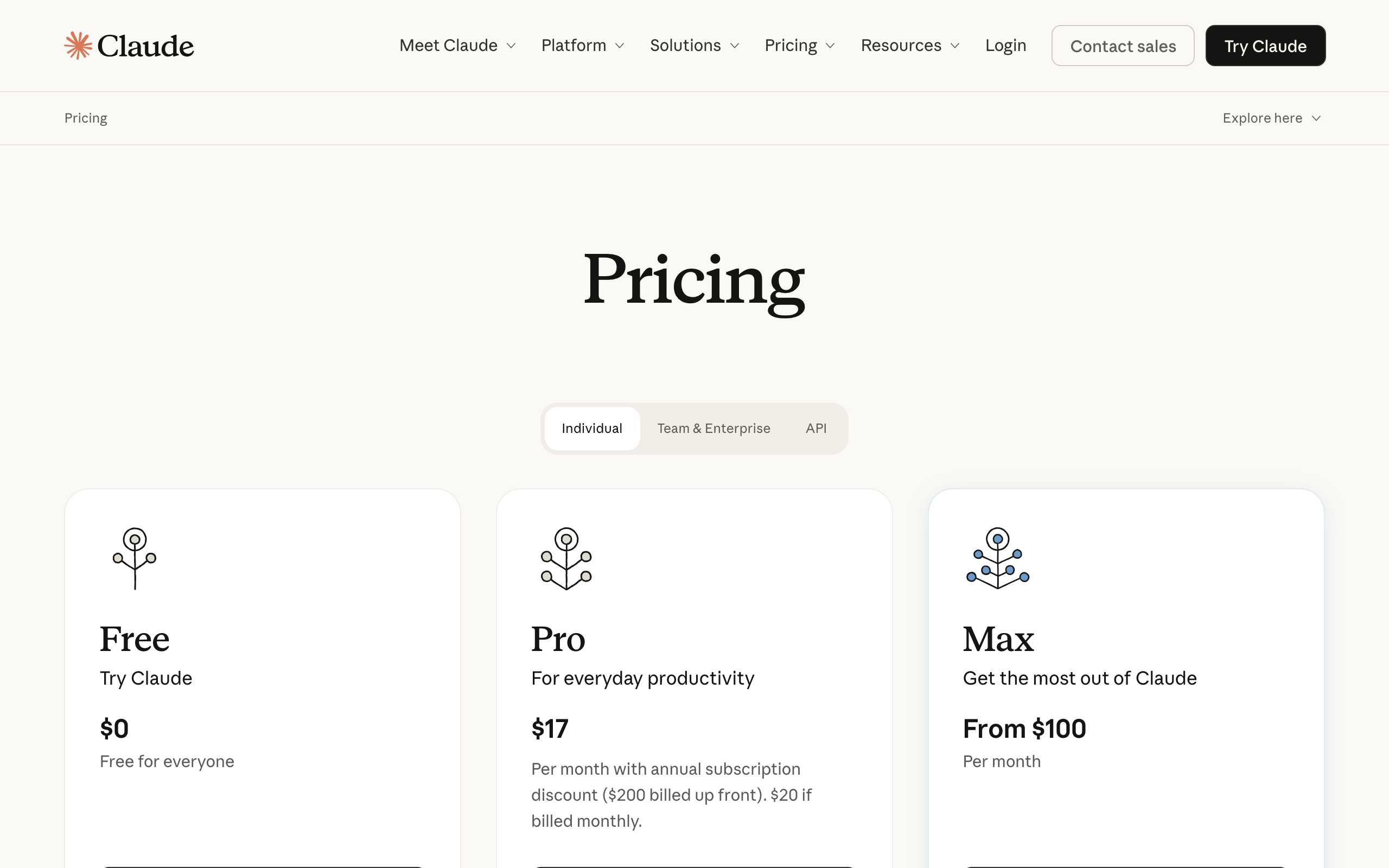
Pricing is $20 a month on Pro, or $17 if you pay for the year. There is a free tier that is enough to test the writing claim in an afternoon, and Max tiers at $100 and $200 a month for 5 times and 20 times the usage, which almost nobody reading this needs.
ChatGPT: the one real exception
If you already pay OpenAI $20 a month and you use it for more than text, the honest answer might be to stay, and I would rather say that than pretend otherwise.
ChatGPT has the widest surface area in the category by a distance. Image generation that is actually good. Voice mode that works well enough to use while walking. The largest catalogue of integrations and custom GPTs. A memory feature people genuinely rely on. GPT-5.6 Sol sits one tenth of a point behind Claude Opus 5 on the aggregate, so you are not accepting a weak model to get all that.
The trade is that the writing needs more editing and it is more eager to please. Ask it to critique your plan and you will more often get encouragement with a caveat attached than the actual problem with the plan. For some jobs that does not matter. For anything you will publish, it does.
Straight rule: if your weekly use includes images, voice, or an integration that only exists there, keep ChatGPT and stop reading. If your week is thinking and writing, move.
What each of the rest is actually best at
The other 5 are not worse chatbots so much as different products wearing the same interface. Here is the one job each of them wins.
Gemini, $19.99 a month. The only one that reads your actual Gmail, Docs, Drive and Calendar natively, because Google owns them. If your working life sits inside Workspace, that native access beats a slightly smarter model that cannot see any of it. Google AI Ultra exists at $249.99 a month and is priced for people who are not you.
Perplexity, $20 a month. Not really a chatbot. It is a search engine that answers in prose and cites the pages it used, and for 'find me the source for this' it beats everything above. I use it to check claims, not to produce anything.
Grok, $30 a month for SuperGrok. Wired into live X, so it is the one that knows what happened an hour ago. Fewer guardrails than the others, which cuts both ways. There is a free tier at roughly 10 prompts per 2 hours, an $8 X Premium tier, a $10 Lite, and a $300 Heavy tier.
DeepSeek, free. No monthly plan exists. Web chat costs nothing and the reasoning is genuinely strong, with the API billed per token if you build on it. If budget is the binding constraint, this is the serious free option and it is not close.
Copilot, $19.99 a month inside Microsoft 365 Premium. The standalone consumer Copilot Pro plan is gone, folded into the Office bundle. Most people who have it did not choose it, they were assigned it. It is competent inside Word, Excel and Teams and rarely the reason anyone opens a chatbot.
Where Claude loses
A page that admits nothing reads like a paid placement, so here are the 3 real ones.
No image generation. None. If you want a picture, you are opening something else. ChatGPT and Gemini both do this and Claude does not, and no amount of reasoning quality substitutes.
Usage limits bite on the $20 tier. A long working session on Pro can hit a cap and leave you waiting for the window to reset, which is infuriating mid-task. The fix is the $100 Max tier, and that is a real 5 times price jump, not a rounding error.
The ecosystem is thinner. Fewer plugins, fewer third-party integrations, a smaller pile of community templates. If your workflow depends on connecting a chatbot to 9 other apps through a marketplace, ChatGPT has more of them.
None of those change the call for me, because I need words I can publish and problems solved correctly more than I need a picture. Your weighting might genuinely differ, and if it does, the table above is the honest map.
The call
Keep one. Almost nobody needs 2 of these and paying $40 a month for overlapping tools is exactly the habit this site exists to argue with.
If words are your output, or you want the model to do work rather than describe it: Claude, $20 a month, and take the free tier for a week first. If images, voice or a specific integration are in your actual weekly routine: keep ChatGPT. If your life is inside Google Workspace: Gemini, and the native access settles it. If you need citations more than conversation: Perplexity. If you need to spend nothing: DeepSeek, and do not feel like you are settling.
The test that decides it is cheap to run and nobody does it. Take a real task from your week, the kind you would normally do yourself, and give it to the free tier of your top 2. Then count how many lines of the output you kept. That number is the answer, and it is worth more than every leaderboard on this page. Once you have picked, the next question is what else the subscription lets you cancel, and that is a longer conversation.
The best AI chatbot in 2026 is Claude, at $20 a month, and the reason is narrower than the marketing suggests: it reasons through a hard problem more reliably than anything else and it writes in a way you do not have to rewrite. That is the whole call. The honest complication is that most people reading this already pay OpenAI $20 a month for ChatGPT, which is genuinely excellent at things Claude is not, and nobody needs 2 of these. This page is about which one earns the seat.
Honest FAQ
What is the best AI chatbot in 2026?
Claude, at $20 a month. It leads the aggregate benchmark tables as of August 2026 with Opus 5, and more importantly it produces writing and reasoning you edit less. ChatGPT is a close second and genuinely better for images, voice and integrations, so if those are in your weekly routine the honest answer flips.
Is Claude better than ChatGPT?
For thinking and writing, yes, and not marginally. For breadth, no. ChatGPT has image generation, voice mode and a far larger integration catalogue, and GPT-5.6 Sol sits within a tenth of a point of Claude Opus 5 on the aggregate scores. Pick on what your week actually contains rather than on a leaderboard.
Which AI chatbot is free?
All of them have a free tier, but DeepSeek is the only one with no paid consumer subscription at all. Its web chat is free and the reasoning is genuinely strong. Claude, ChatGPT, Gemini, Perplexity and Grok all offer free tiers that are capped and are best treated as a trial rather than a plan.
Do I need to pay for 2 AI chatbots?
No, and paying twice is the most common mistake in this category. The overlap between any 2 of these is close to total for everyday use. Keep one at $20 a month, and use free tiers for the one specific job your paid tool cannot do, such as opening Perplexity when you need a citation.
Are AI benchmarks worth paying attention to?
They are useful for ruling models out, not for picking between the top 4. As of August 2026 the first and second placed models are one tenth of a point apart on the aggregate, and the model that wins the human-preference arena is not the one that wins the exams. Use them as a floor check, then test on your own work.
What does Claude cost?
There is a free tier, Pro is $20 a month or $17 a month billed annually, and Max tiers run $100 a month for 5 times the usage and $200 a month for 20 times. Most people are correctly served by Pro. The usual reason to move up is hitting the usage cap in the middle of long working sessions.