The Best Cold Email Software (2026): Instantly, and the Trap Most People Buy First.
The best cold email software is Instantly, from $37/mo and not priced per seat. Compared against Lemlist, Apollo, Smartlead, Clay and Hunter, with 2026 pricing.
- The pick: Instantly, $37/mo for 5,000 active leads and 10,000 emails, $97/mo at 25,000 leads. Priced per workspace, not per seat.
- The exception: Lemlist, from $39/mo, but that is per user. 3 people on it runs $117 to $297 a month for the same work.
- Apollo is a database first. Free tier gives 900 credits per seat per year, paid runs $49 to $119 per user per month on annual billing.
- Smartlead is the closest rival to Instantly at $39 to $174/mo, and agencies pay $29 per client on top.
- Clay is not a sender at all. It is enrichment, repriced in March 2026, and Launch starts at $185/mo.
- Finding contacts and sending to them are 2 jobs. Almost every bad outbound spend comes from buying one tool to do both.
The 2 jobs everyone buys as one
Cold email looks like a single task and is actually 2, and almost every wasted dollar in this category comes from not separating them.
Job 1 is finding the right people. That is a data problem. You need contacts that match a real target, verified addresses, and enough context about each one to say something specific. Apollo, Clay, Hunter and Snov all live here.
Job 2 is landing in the inbox. That is an infrastructure problem, and it has almost nothing to do with the first. It is about sending domains, warmup, how many messages leave each mailbox per day, and whether your setup looks like a person or a bulk broadcaster. Instantly, Smartlead and Lemlist live here.
The tools that claim both are the ones to be careful with, because one half is always the loss leader. A database that throws in sending is not going to give you serious deliverability infrastructure at the same price, and a sender that throws in a contact list is not going to give you good data. Buy the one that matches your actual bottleneck. If your emails are landing but nobody replies, you have a data problem. If nobody replies to anything, check whether you are landing at all first.
Instantly: the pick, and the pricing model is half the reason
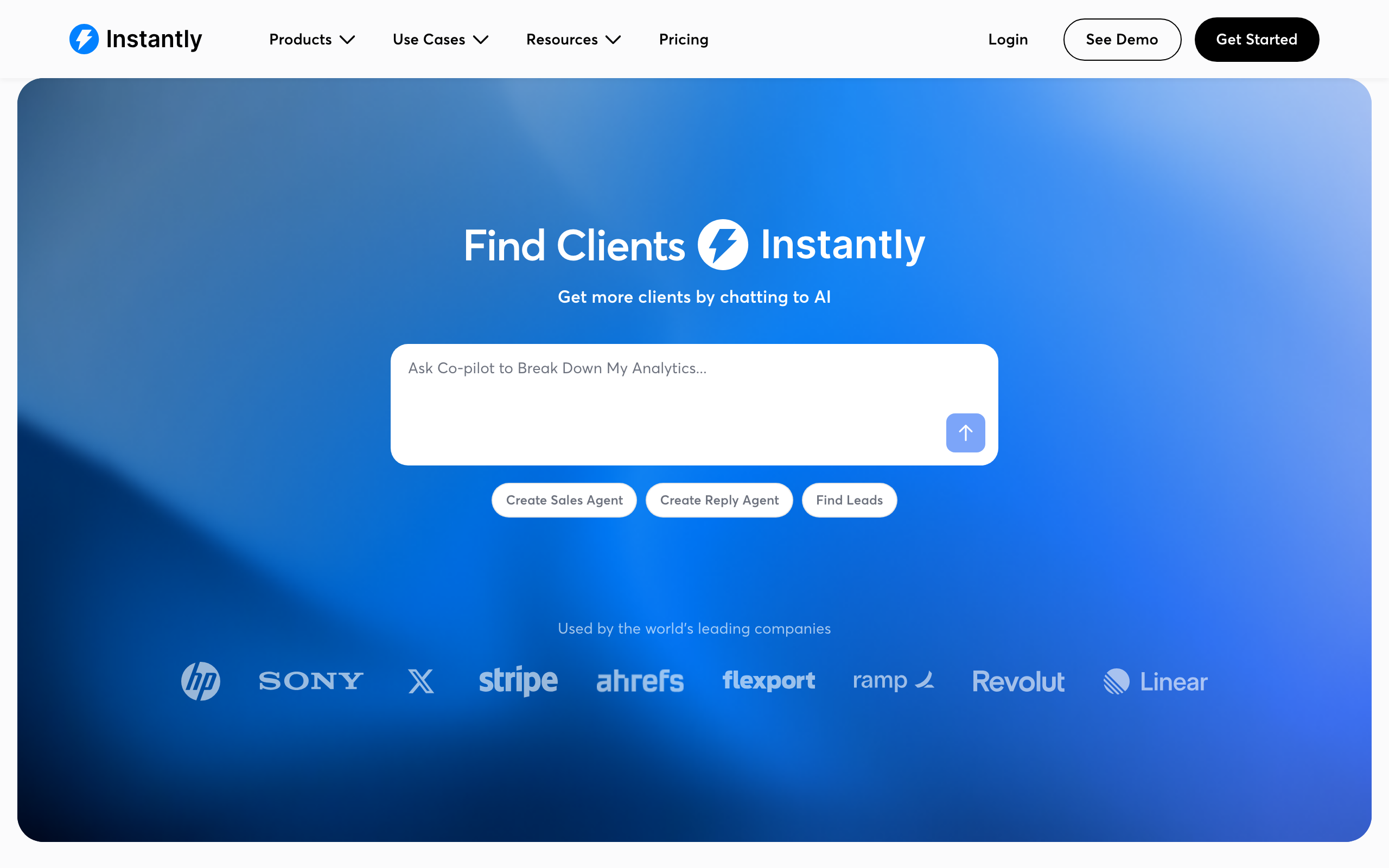
Instantly is built for job 2 and does not pretend otherwise. You connect a set of sending mailboxes, it warms them by circulating real-looking mail between them until they have a sending reputation, then it rotates your campaign across all of them so no single mailbox carries suspicious volume. That rotation is the feature. It is what lets one person send at a volume that would get a single mailbox flagged in a week.
Growth is $37 a month for 5,000 active leads and 10,000 emails a month. Hypergrowth is $97 a month for 25,000 active leads and 100,000 emails. Here is the part that matters more than either number: it is priced per workspace, not per seat. Add a second person and the bill does not move.
Run that against the alternative for a 3 person team and the gap stops being academic. Instantly sits in the $30 to $80 range regardless of headcount. A per-seat tool at $39 a head is $117 a month for the same campaigns, and on the multi-channel tier it is closer to $300. Same emails, same leads, triple the invoice, and the only difference is how the vendor decided to charge.
What it is not: a research tool. The contact data is thin compared to a real database, and it will not tell you anything interesting about the people on your list. Pair it with something from the finding half, or build the list yourself.
| Tool | Price | What it actually is | Who it's for |
|---|---|---|---|
| Instantly | $37/mo Growth; $97/mo Hypergrowth | Sending infrastructure. Warmup and inbox rotation built in. | Anyone sending real cold volume, any team size |
| Lemlist | From $39/mo per user | Sender with the best personalization layer in the category. | Small teams sending fewer, better emails |
| Smartlead | $39 to $174/mo, plus $29 per agency client | The closest rival to Instantly. Same job, agency billing. | Agencies running many client workspaces |
| Apollo | Free tier; $49 to $119/user/mo annually | A contact database with sending attached. | Finding contacts, not sending to them |
| Clay | Free tier; Launch $185/mo; Growth $495/mo | Enrichment and research. Not a sender. | Teams whose bottleneck is data, not delivery |
| Hunter | $34/mo for 2K credits; $104/mo for 10K | Email finding and verification. | Verifying a list you already built |
| Snov | $39/mo for 1K credits; $99/mo for 5K | Cheaper finder with light sending attached. | Small budgets, low volume |
Lemlist: the exception, and it is about the message not the volume
Lemlist has the best personalization layer in the category and it is not particularly close. Custom images with the recipient's own site or logo rendered into them, dynamic landing pages per contact, video that addresses them by name. It also runs LinkedIn and calls alongside email on the multi-channel tier, so a sequence can touch someone 3 ways.
That is a real answer to a real problem. If you are sending 40 extremely considered emails a week to named accounts you have researched, Lemlist will beat Instantly on reply rate, because at that volume the message matters more than the infrastructure.
The catch is the pricing model, and you should look at it before you fall for the feature list. Email Outreach is $39, Multi-Channel $69, Enterprise $109 and up, and every one of those is per user, per month. One person, fine. 5 people and you are paying more for the tool than most teams pay for their entire outbound stack. (This is the single most common way a cheap-looking headline price turns into the most expensive line on the invoice.)
Straight rule: low volume, high research, 1 or 2 senders, Lemlist earns it. Real volume or more than 2 people, the per-seat model stops making sense and Instantly is the better buy.
Apollo: a database being used as a sender
Apollo is the tool most people buy first, and it is a genuinely good product being used for the wrong job. It is a contact database, a large one, with search filters that let you build a targeted list quickly. That part works.
3 things to understand before it becomes your sending tool.
The emails are behind credits. The free plan gives 900 credits per seat per year, which sounds generous until you realise a credit is spent to reveal or verify a contact, not to send to one. You are paying per contact for the data you need in order to decide whether that contact is even worth emailing. Paid runs $49, $79 and $119 per user per month on annual billing, or $65, $99 and $149 month to month.
It is per seat too. Same arithmetic as Lemlist. 3 people on Professional is $237 a month before you have sent anything.
Everyone is drawing from the same well. Apollo's database is enormous and widely used, which means the contacts you find are the contacts your competitors found, filtered the same way, and emailed with the same generic first line. That is not Apollo's fault. It is what happens when a database becomes the default, and it is the strongest argument for building your own list from a source your competitors are not all scraping.
Use it as a research tool where it is strong. Do not make it the thing your deliverability depends on.
The other 4, briefly
Smartlead, $39 to $174 a month. The closest thing to a straight swap for Instantly, same warmup and rotation approach, priced on lead volume. The thing to check is the agency model: client workspaces are $29 each on top, so 10 clients pushes a $94 plan closer to $400. If you are one business, it is a fair fight with Instantly and worth trialling both. If you are an agency, do the client math before committing.
Clay, free tier, Launch $185 a month, Growth $495. Not a sender. It is an enrichment engine: it takes a list and runs it through dozens of data sources and AI steps to fill in what you are missing. It repriced in March 2026 into data credits plus actions, and the entry paid tier is $185, which tells you who it is for. Powerful, expensive, and only correct when your bottleneck is genuinely the quality of your data.
Hunter, $34 a month for 2,000 credits, $104 for 10,000. Narrow and honest. It finds and verifies email addresses and does not pretend to be a platform. If you build lists yourself and just need addresses confirmed before you send, this is the cheapest sane way to do it.
Snov, $39 a month for 1,000 credits, $99 for 5,000. A cheaper finder with light sending attached. Fine at small scale and on a tight budget. It is the tool you outgrow rather than the one you settle on.
Why sends land in spam, in one section
You can buy the right tool and still fail here, so it is worth knowing what the software is actually protecting you from.
Bounces are the fastest way to wreck a domain. Every message to an address that no longer exists tells the provider your data is bad. Enough of them and your domain gets filtered, including for the people who genuinely want to hear from you. This is why verification is not optional and why sending to a raw exported list is the single most expensive shortcut in outbound.
Shared infrastructure gets recognised. Bulk platforms that send everyone's mail through the same pool, rewrite your links for click tracking, and wrap everything in HTML produce a signature that providers identify before a human reads a word.
Your main domain should not be doing this. The standard practice is a separate sending domain, warmed for a few weeks before real volume, so that if something goes wrong the damage does not reach the address your customers already use.
That is the shape of the problem. Instantly and Smartlead automate the warmup and rotation parts of it, which is precisely why they are worth paying for and why a database with sending bolted on is not a substitute.
The call
Sending real volume, or more than one person is going to touch this: Instantly, $37 a month to start, and the per-workspace pricing means it does not punish you for having a team. That is the pick.
1 or 2 people sending a small number of heavily researched emails: Lemlist, and accept the per-seat bill because at that volume the personalization is what earns the reply. Running an agency: price Smartlead against Instantly with your real client count, because the $29 per client changes the answer. Bottleneck is data quality rather than delivery: Clay, and be honest about whether you are ready for $185 a month. Just need addresses verified: Hunter at $34.
And if you take one thing from this page, take the split. Buy for the job you are actually blocked on. A database will not fix your deliverability and a sender will not fix your targeting, and the tools that promise both are quietly weak at one of them. The same logic runs through the rest of the stack: one tool per job, chosen on purpose.
The best cold email software in 2026 is Instantly, from $37 a month, because it is built around the part that actually decides whether outbound works: warming inboxes, rotating between them, and landing in a real inbox at volume. The trap most people buy first is a contact database with sending bolted on, usually Apollo, which sells you the list and charges credits for the emails inside it. That is a different product solving a different problem, and buying it as your sending tool is why a lot of first campaigns go nowhere.
Honest FAQ
What is the best cold email software in 2026?
Instantly, from $37 a month. It handles the part that decides whether outbound works at all, warming your sending mailboxes and rotating campaigns across them so no single inbox carries flagged volume. It is priced per workspace rather than per seat, which makes it substantially cheaper than Lemlist or Apollo for any team above one person.
Is Instantly better than Lemlist?
For volume and for teams, yes, and the pricing model is most of the reason. Instantly is billed per workspace at $37 to $97 a month while Lemlist is billed per user from $39, so 3 senders costs $117 to $297 on Lemlist for the same campaigns. Lemlist wins on personalization, so at low volume with heavy research it can still be the right call.
Should I use Apollo for cold email?
Use it to find contacts, not to send them. Apollo is a contact database with sending attached: emails sit behind credits, pricing is per seat at $49 to $119 a month on annual billing, and its database is common enough that your competitors are pulling the same names with the same filters. It is a good research tool being asked to do an infrastructure job.
What is the difference between Clay and Apollo?
Apollo is a database you search. Clay is an engine that takes a list you already have and enriches it by running each row through many data sources and AI steps. Clay starts at $185 a month on its Launch plan after its March 2026 repricing, so it only makes sense when poor data quality is genuinely what is holding your outbound back.
Why do my cold emails go to spam?
Usually 3 causes. Bounces from unverified addresses tell providers your data is bad and get your domain filtered. Shared sending infrastructure with rewritten tracking links has a signature providers recognise as bulk. And sending from your main company domain means any damage hits the address your existing customers use. A separate warmed sending domain plus verified addresses fixes most of it.
How much should cold email software cost?
For one business sending real volume, $37 to $97 a month covers it on Instantly or $39 to $174 on Smartlead. Add a verification tool like Hunter at $34 if you build your own lists. If you are paying more than about $150 a month as a solo operator, check whether you are on a per-seat plan or paying for a database you are only using as a sender.