The Best Platform to Sell Digital Products (2026): ThriveCart, After About 90 Sales.
ThriveCart is $495 once instead of 10% forever, and it pays for itself in about 90 sales. Compared with Gumroad, Lemon Squeezy, Payhip, Podia and Kajabi.
- The pick: ThriveCart, $495 one-time for Standard or $690 for Pro. No monthly fee, no cut of your revenue, ever.
- Breakeven vs Gumroad on a $50 product is roughly 90 sales. Below that, percentage pricing is genuinely cheaper.
- Gumroad is 10% + $0.50 per sale and rises to 30% on anything Discover sends you. Simple, and expensive at volume.
- Lemon Squeezy takes 5% + $0.50 but acts as merchant of record, so it files your VAT and sales tax. That is worth real money to some sellers and nothing to others.
- Stan Store is $29/mo with no platform cut, and is the pick if your whole business runs through a link in bio.
- Kajabi starts at $179/mo. It is a full course platform, not a checkout, and most people buying it do not need it.
- One product and no ambition to scale? A Stripe payment link and a delivery email costs you 2.9% and nothing else.
2 questions decide this, and neither is about features
Every platform on this page can take money and deliver a file. That part was solved years ago. What actually separates them is 2 decisions, and almost nobody makes them consciously.
One: do you want a bill or a cut? Some charge a flat fee and leave your revenue alone. Others take a percentage of every sale forever and charge nothing up front. Neither is a trick. Which one is cheaper depends entirely on how much you sell, and the crossover point is calculable, which we do in the next section.
2: who is legally selling the product? This sounds like paperwork and is the most expensive detail on the page. A platform acting as merchant of record is the seller of record on the transaction, which means it collects and files VAT and sales tax for every country your buyer might live in. Lemon Squeezy and Gumroad do this. ThriveCart, Stan Store and Podia do not: they are tools you use to sell, and the tax obligation stays yours.
If you sell to a handful of countries and have an accountant, that is nothing. If you sell a $29 template to buyers in 30 countries, it is the difference between a business and a compliance problem. Answer both questions and the shortlist writes itself.
The arithmetic nobody runs before they pick
Take a $50 digital product, because it is a realistic price and the maths is clean.
On Gumroad you pay 10% plus $0.50, so $5.50 a sale, and payment processing sits on top of that. On ThriveCart you pay $495 once and then nothing per sale beyond Stripe's usual 2.9% plus $0.30, which every platform here passes through anyway.
So the honest comparison is $5.50 a sale against $495 up front. Divide and the crossover is 90 sales. Sell fewer than 90 units of a $50 product across the entire life of your business and Gumroad genuinely cost you less. Sell 500 and Gumroad has taken $2,750 while ThriveCart took $495.
Run it at $200 and it gets brutal: Gumroad's cut is $20.50 a sale, so the crossover arrives at sale 25. Run it at $9 and the crossover is around 350 sales, which is a genuinely long way away for most people. (This is why the answer flips depending on your price point, and why 'best platform' articles that ignore your price are guessing.)
The reason this matters more than it looks: percentage pricing is invisible. It is taken at the moment money arrives, when you are in the least analytical mood you will ever be in, and it never generates an invoice you look at. A $495 charge stings once and then stops. 10 percent does not sting at all and never stops.
| Platform | Price | What it takes per sale | Who it's for |
|---|---|---|---|
| ThriveCart | $495 once (Pro $690) | Nothing beyond Stripe's 2.9% + $0.30 | Anyone past roughly 90 sales who owns their traffic |
| Stan Store | $29/mo (Pro $99/mo) | Nothing beyond processing | Creators selling from a link in bio |
| Lemon Squeezy | No monthly fee | 5% + $0.50, plus 1.5% international | Sellers who want VAT and sales tax handled for them |
| Gumroad | No monthly fee | 10% + $0.50, or 30% via Discover | First sales, tiny catalogues, testing an idea |
| Payhip | Free, or $29/mo, or $99/mo | 5% free tier, 0% on the $99 plan | Sellers who want a free start and a path off the fee |
| Podia | $39/mo (Shaker $89/mo) | 0% on the higher plan | Course plus community in one place |
| Whop | Free | 3% on automated delivery, plus processing | Discord and Telegram community access |
| Kajabi | $179 to $499/mo | 2.7% to 2.9% + $0.30 | Established course businesses with real budget |
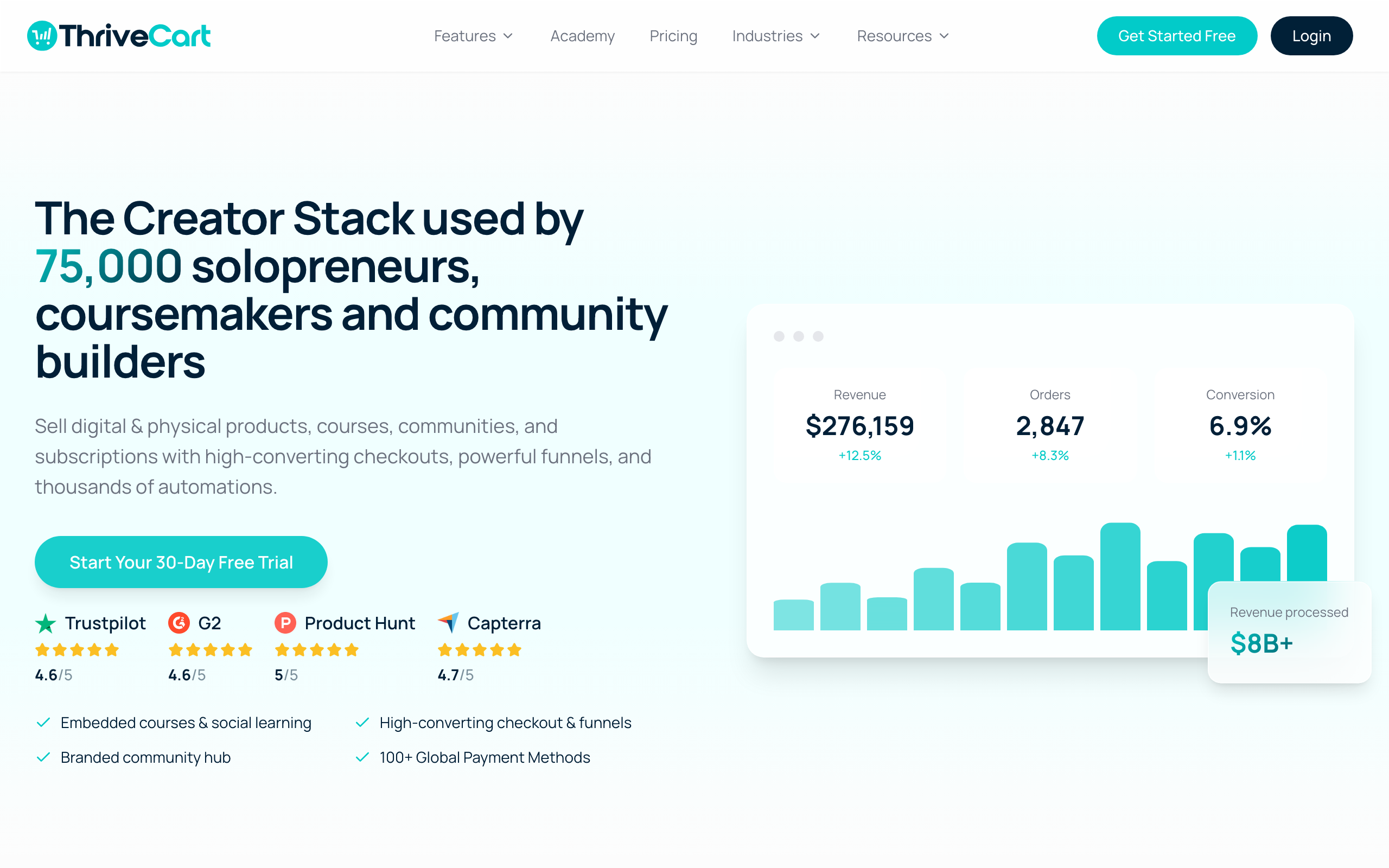
ThriveCart: the pick
ThriveCart is $495 once for Standard, or $690 for Pro which adds the affiliate centre, subscription saver and JV contracts. There is no monthly fee and no revenue share, and the licence does not expire.
The checkout is the actual product. One-click upsells that fire after the card is charged, order bumps on the checkout page itself, cart abandonment, multiple payment options, and a checkout editor that produces something that converts rather than something that merely works. This is the part people underestimate: the difference between a mediocre checkout and a good one is measured in percentage points of conversion, and on a product you are going to sell for years those points are worth considerably more than $495.
What it is not: a storefront, a course platform, or a marketplace. It will not send you a single customer. It is the cash register, not the shop, and if you do not already have traffic it will sit there doing nothing. That is the honest limit.
2 more caveats worth saying plainly. The tax obligation stays with you, so if you sell internationally at any scale you are handling VAT yourself or paying someone to. And the interface has a slightly dated feel compared to newer tools. Neither has ever cost me a sale, but I would rather you hear it here.
Stan Store: the exception, and it is a phone
Stan Store is $29 a month for Creator or $99 for Creator Pro, with no platform cut on either, just the standard processing fee. It is built for one shape of business: your audience is on Instagram or TikTok, they tap the link in your bio, and everything you sell has to work on a phone in about 4 taps.
For that shape it beats ThriveCart, and not narrowly. The whole thing is a mobile-first storefront rather than a checkout you have to build a page around. Digital products, coaching calls, courses and your links all live in the same place, and it is fast enough to set up in an evening.
The trade is that you are renting. At $29 a month you have paid $348 a year, so in 17 months you have spent more than ThriveCart's lifetime licence and you own nothing. That is a fine deal while the convenience is doing real work for you and a bad one the moment it stops. Take Stan Store if link-in-bio is genuinely how you sell. Take ThriveCart if you have your own site.
The merchant-of-record lane: Lemon Squeezy and Gumroad
These 2 charge a percentage and are worth it for exactly one reason, so let me be specific about what you are buying.
Lemon Squeezy: 5% plus $0.50 per sale, with 1.5% added for international cards, 1.5% for PayPal and 0.5% for subscriptions. In exchange it becomes the legal seller and handles VAT and sales tax filing across jurisdictions. If you are a solo operator selling software or templates worldwide, that is a genuine service you would otherwise pay an accountant for, and 5% is a defensible price for not thinking about EU VAT ever again. It is the best-designed product in this group by some distance.
Gumroad: 10% plus $0.50, no monthly fee, also merchant of record. It is the fastest way on earth to sell your first digital product, and I would still send a complete beginner here for their first 10 sales rather than have them spend $495 on a hunch. The catch is what happens after: 10% is double Lemon Squeezy's rate for a broadly similar service, and anything the Discover marketplace sends you is charged at 30%. Discover does bring real buyers, so that is a trade rather than a penalty, but you should know the number before you switch it on.
The clean way to hold this: Gumroad to start, Lemon Squeezy if tax handling is the thing you actually need, ThriveCart once volume makes percentages absurd.
The rest, and who each one is genuinely for
Payhip, free or $29 or $99 a month. The free tier takes 5% and the $99 plan takes nothing, which makes it the one platform with a sensible path from beginner to volume without migrating. Underrated, and the most reasonable free option here.
Podia, $39 a month for Mover or $89 for Shaker. Shaker removes transaction fees. Podia bundles courses, digital downloads, community and email into one place. Take it if you want one tool for all of that and accept a monthly bill for the simplicity.
Whop, free, 3% on sales with automated delivery plus 2.7% and $0.30 processing. It is really about selling access to a Discord or Telegram community and automating who gets in. It dropped its 30% marketplace commission in May 2025, which made it substantially more reasonable. Niche, but the best answer inside that niche.
Kajabi, $179 to $499 a month plus 2.7% to 2.9% per transaction depending on tier. It is a full course business platform with site, email and funnels included, and it is priced accordingly. The common mistake is buying it to sell one $47 product, where you would need to clear about $2,150 a year in profit just to cover the Basic plan. Correct for an established course business, expensive for everyone else.
Shopify is worth a line: if you already run a store for physical goods, add the digital products there rather than bolting on a second platform. One less login beats a marginally better checkout.
When you need none of these
You have one product, you are selling it to your own audience, and you do not plan a catalogue. In that case a Stripe payment link and an email that delivers the file covers the entire job for 2.9% plus $0.30 and no platform at all.
It takes about 20 minutes. Stripe generates the link, you paste it wherever you sell, and you send the file manually or with a simple automation. No monthly bill, no revenue share, no migration later because there is nothing to migrate. The parts you give up are the upsell flow, the affiliate programme, the tax handling and the abandoned cart emails, and for exactly one product sold occasionally, you do not need any of them.
This is the answer nobody selling a platform will give you, so it is worth saying plainly: the best tool here is sometimes no tool. Buy the platform when you have proof the product sells, not to feel like you have a business. The same logic runs through the payments piece.
The call
Past roughly 90 sales of a $50 product, or anywhere near it, and you own your own traffic: ThriveCart, $495 once, best checkout in the category, and no percentage for the rest of the product's life. That is the pick.
Selling from a link in bio to a phone-first audience: Stan Store at $29 a month. Selling worldwide and you want VAT handled for you: Lemon Squeezy at 5%, and it is worth it. Making your first sales this month: Gumroad, take the 10%, prove the product, and switch when the arithmetic turns. Want a free start with a route off the fee later: Payhip. Selling Discord access: Whop. One product and no plans: a Stripe link.
The mistake this category punishes is buying for the business you describe rather than the one you have. A percentage is the right price for a business that has not proven itself, and a flat fee is the right price for one that has. Know which one you are, buy accordingly, and switch when the numbers say so rather than when a launch email does.
The best platform to sell digital products in 2026 is ThriveCart, at $495 once instead of a percentage forever, and it has the best checkout and upsell flow in the category. On a $50 product it pays for itself somewhere around the ninetieth sale compared to Gumroad, and every sale after that is a rounding error instead of a tax. The one thing it does not do is handle your sales tax, which is the entire reason Lemon Squeezy exists, and that trade is what this page is really about.
Honest FAQ
What is the best platform to sell digital products in 2026?
ThriveCart, at $495 once, for anyone selling with any consistency to their own audience. It takes no percentage of your sales and has the strongest checkout and upsell flow in the category. Below about 90 sales of a $50 product, a percentage-based platform like Gumroad or Lemon Squeezy is genuinely cheaper and the honest answer.
Is ThriveCart worth it?
It comes down to volume and the maths is quick. ThriveCart is $495 once. Gumroad takes 10% plus $0.50, which is $5.50 on a $50 product, so the crossover is about 90 sales. At a $200 price point the crossover falls to 25 sales. At $9 it stretches to roughly 350. Work out your price and your realistic annual volume before deciding.
What is a merchant of record and why does it matter?
A merchant of record is the legal seller on the transaction, which means it collects and files VAT and sales tax in your buyer's country instead of you. Lemon Squeezy and Gumroad do this. ThriveCart, Stan Store and Podia do not, so that obligation stays with you. If you sell internationally at any scale, this single detail can be worth more than the fee difference.
Gumroad or ThriveCart?
Gumroad while you are proving the product, ThriveCart once it is proven. Gumroad has no up-front cost and handles your tax, which is exactly what you want for your first 10 sales. Its 10% plus 50 cents becomes the most expensive line in your business at volume, and that is the point to move.
What is the cheapest way to sell a digital product?
A Stripe payment link and a delivery email, at 2.9% plus $0.30 and no platform fee at all. It takes about 20 minutes to set up. You give up upsells, affiliate tracking, tax handling and abandoned cart emails, none of which matter when you are selling one product occasionally to your own audience.
Do I need Kajabi to sell a course?
Almost certainly not. Kajabi runs $179 to $499 a month plus transaction fees, so on a $47 course you need roughly $2,150 of annual profit just to cover the entry plan. It is built for established course businesses that want site, email and funnels in one system. To sell a course to an audience you already have, ThriveCart plus a delivery tool costs a fraction of it.