Substack vs Beehiiv (2026): Which One You Actually Need.
Substack costs $0 until a reader pays you, then 10% forever. beehiiv's free tier cannot charge at all, and the tier that can starts at $49 a month.
- Substack: $0 to publish, unlimited subscribers, no plans. It takes 10% of paid subscription revenue with no cap and no volume discount, for as long as that reader keeps paying.
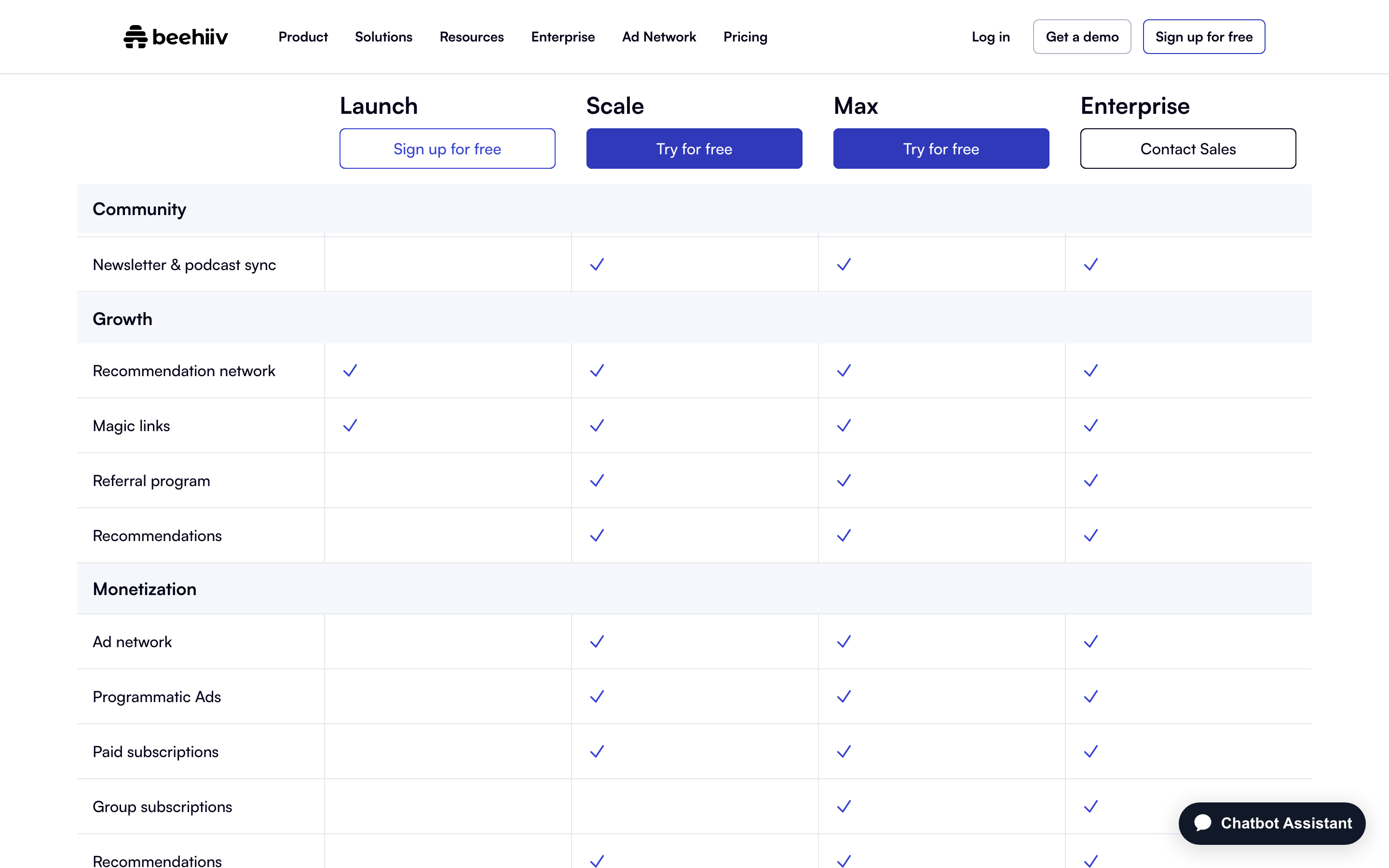
- beehiiv Launch is free to 2,500 subscribers and cannot charge for subscriptions at all. Paid subs, the referral program and the ad network all start on Scale.
- beehiiv Scale is priced off your list size, not your revenue: $49/mo at 1,000 subscribers, $89 at 5,000, $109 at 10,000, $329 at 100,000 (billed monthly, checked 20 August 2026).
- So the crossover is ten times beehiiv's bill. $490/mo in paid revenue at 1,000 subscribers, $1,090 at 10,000, $3,290 at 100,000.
- 1,000 subscribers, 3% paying $8 a month, is $240/mo. Substack takes $24. beehiiv wants $49 whether anyone pays or not.
- Same rates at 10,000 subscribers is $2,400/mo. Substack takes $240, beehiiv takes $109. That gap is $1,572 a year for sending the same email.
- Stripe's 2.9% plus 30 cents applies on both sides, so ignore it. Half the comparison posts online stack it onto Substack's 10% and forget beehiiv pays it too.
The question that decides Substack vs beehiiv
Substack if you need readers. beehiiv if you already have them and want to keep more of what they pay you. Everything below is the arithmetic that tells you which one you are, and the exact month it changes.
Clear the false tie first. Both send a good-looking email, both host a website with your posts on it, both let you charge money, both export the list. If you are hoping one of them fails at something basic so the choice makes itself, neither does. I wrote the whole category up in the blogging platform review, and Substack took the pick there for the same reason it takes it here.
What actually separates them is who is responsible for finding your next reader. Substack spends its product budget on discovery: leaderboards, recommendations between writers, Notes, an app people open in a queue at the post office. beehiiv spends its product budget on the machine behind a newsletter that is already working: referrals, segmentation, ad inventory, analytics that tell you something you can act on. One rents you an audience. The other equips you to build one. Price follows that split exactly, which is why the two bills look nothing like each other.
beehiiv's free tier cannot take money
beehiiv Launch is free up to 2,500 subscribers, and it is not a crippled trial. Unlimited sends, a hosted website, a custom domain, podcast support, the AI site builder, API access. For a free newsletter that is a better deal than most paid plans were two years ago.
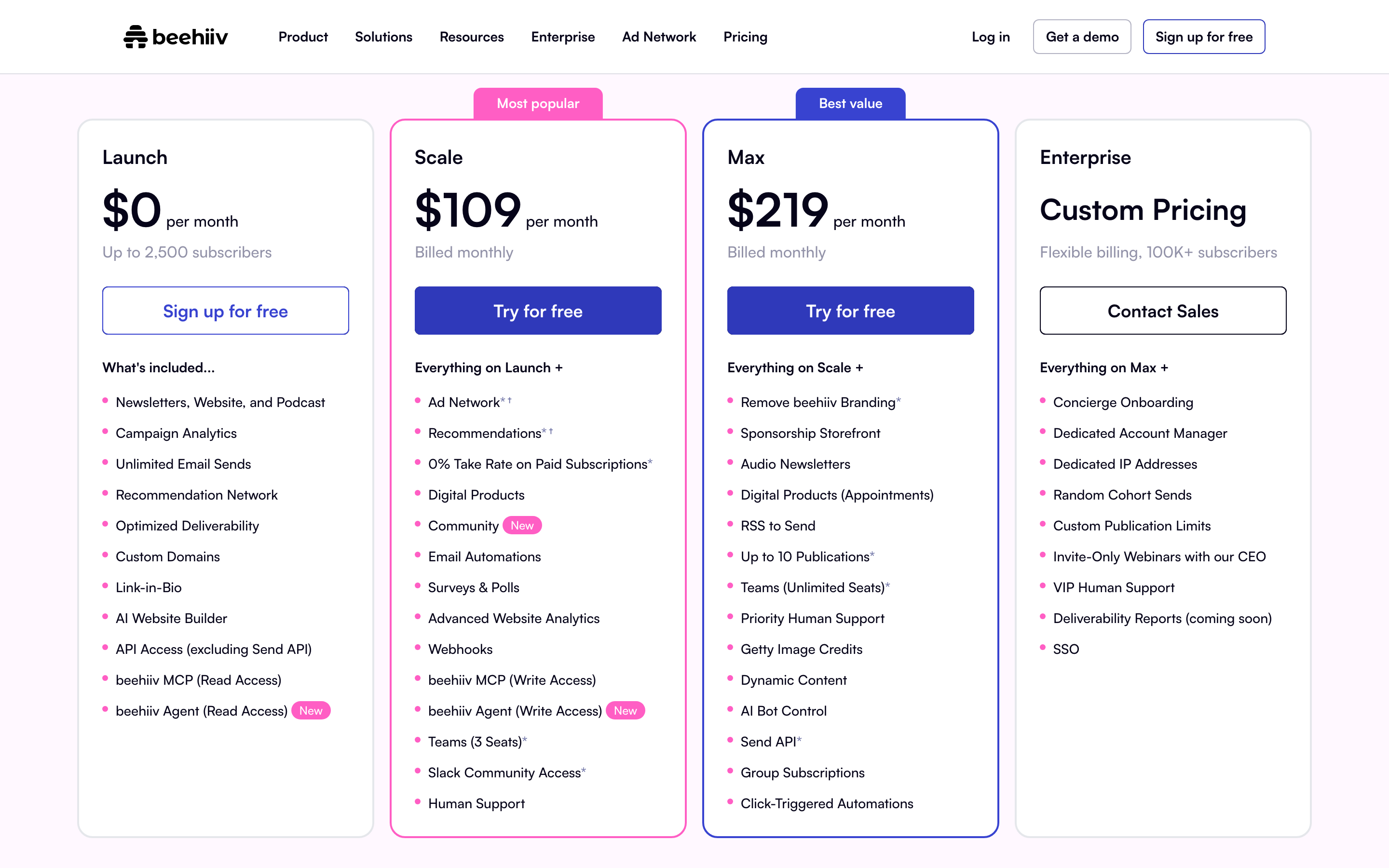
Then you go to switch on paid subscriptions and find the row is blank. Paid subscriptions are not on Launch. Neither is the referral program, the ad network, programmatic ads, or beehiiv's Recommendations placements. Every single feature that turns a list into income sits behind the paid plan, which is a fair business model and a genuinely confusing pricing page. (I sat with beehiiv's own comparison table open for a while before I believed it, so the screenshot is on this page.)
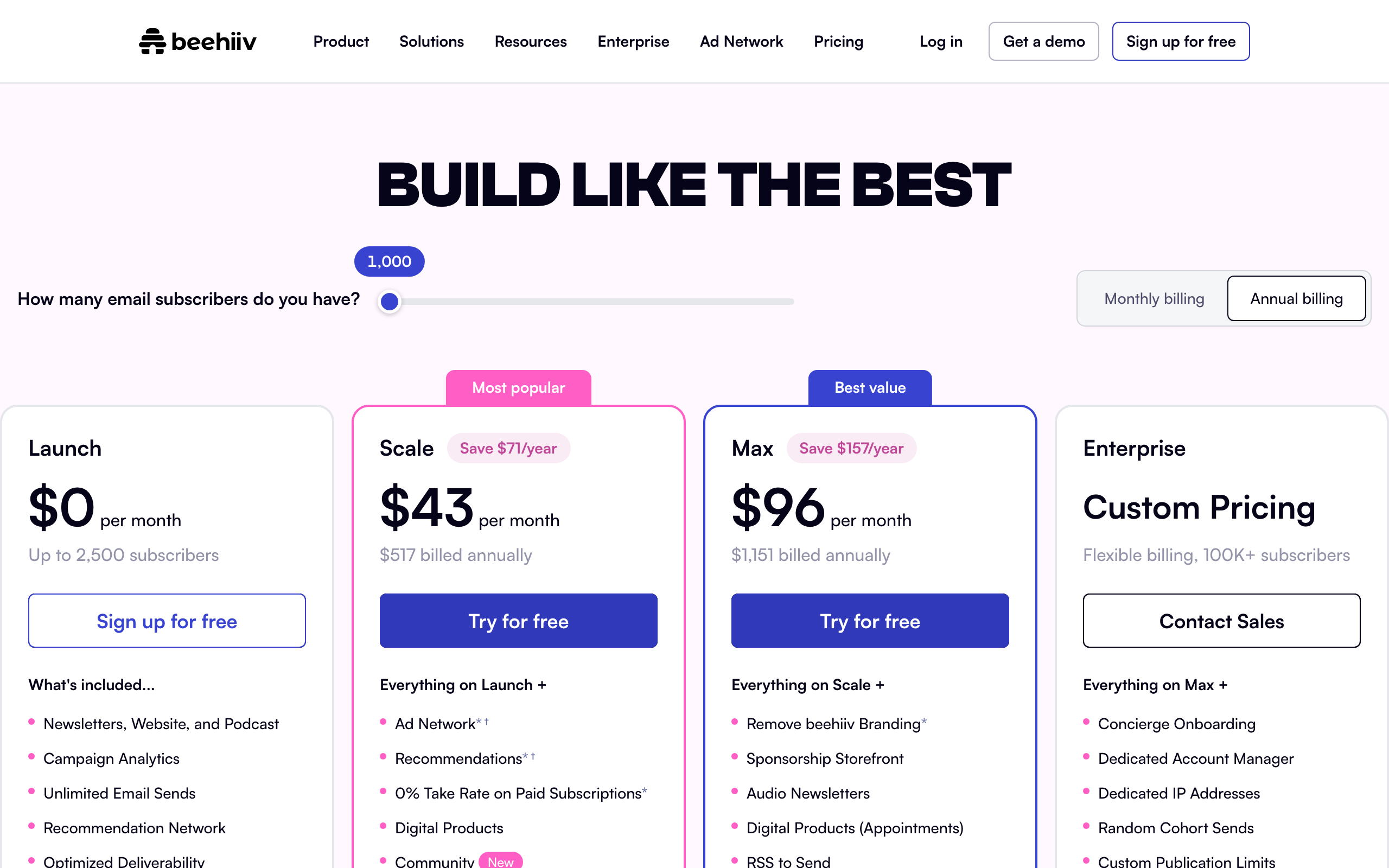
The tier that can charge is Scale, and Scale is priced off your list size rather than your revenue. On monthly billing it runs $49 at 1,000 subscribers, $69 at 2,500, $89 at 5,000, $109 at 10,000, $169 at 25,000 and $329 at 100,000. Annual billing knocks it down: $43 a month at 1,000 subscribers, billed as $517 a year. I moved the slider through every stop on beehiiv's pricing page on 20 August 2026 to get those numbers, because they are not written anywhere as a list.
Sit with what that means. A 9,000-person list that has never earned a dollar costs $109 a month on the tier that would let it start earning. beehiiv's 0% take rate is completely real and it is the loudest thing on their site, but you buy it in advance, at a price set by how many people you have rather than by whether any of them pay you. Our own tool database had beehiiv at $39 a month until this morning. That number is two price changes old, and I have corrected it.
| Option | Price | One-line call | Who it's for |
|---|---|---|---|
| Substack | $0, then 10% of paid subscriptions | Distribution you did not have to build. | Anyone under about $490/mo in paid revenue |
| beehiiv Launch | $0 to 2,500 subscribers | Free, and it cannot take a payment. | Writing a free list before you charge |
| beehiiv Scale | From $49/mo at 1,000 subs | 0% take rate, paid up front instead. | Paid revenue past ten times that bill |
| beehiiv Max | From $109/mo at 1,000 subs | Drops beehiiv's branding, adds group subs. | Newsletters selling seats to companies |
| Substack, no paid tier | $0 | Nothing to decide until someone pays. | Anyone under a few hundred subscribers |
Substack takes 10% forever, and this is what it buys
Substack has no plans, no subscriber limits and no monthly bill. It is free to publish to 200 people or 200,000. When a reader pays you, Substack takes 10% of that payment, with no cap, no volume discount, and no end date on that particular reader. The only bill that can reach you before revenue does is $50, once, if you want a custom domain.
Stripe charges 2.9% plus 30 cents per transaction on top of that, and I want to be blunt about this because the comparison posts are sloppy on it: beehiiv pays the exact same Stripe fee. It is on both sides of the page, so it cancels, and any article that adds it to Substack's 10% to get a scary number and then quietly leaves it off beehiiv's column is selling you something.
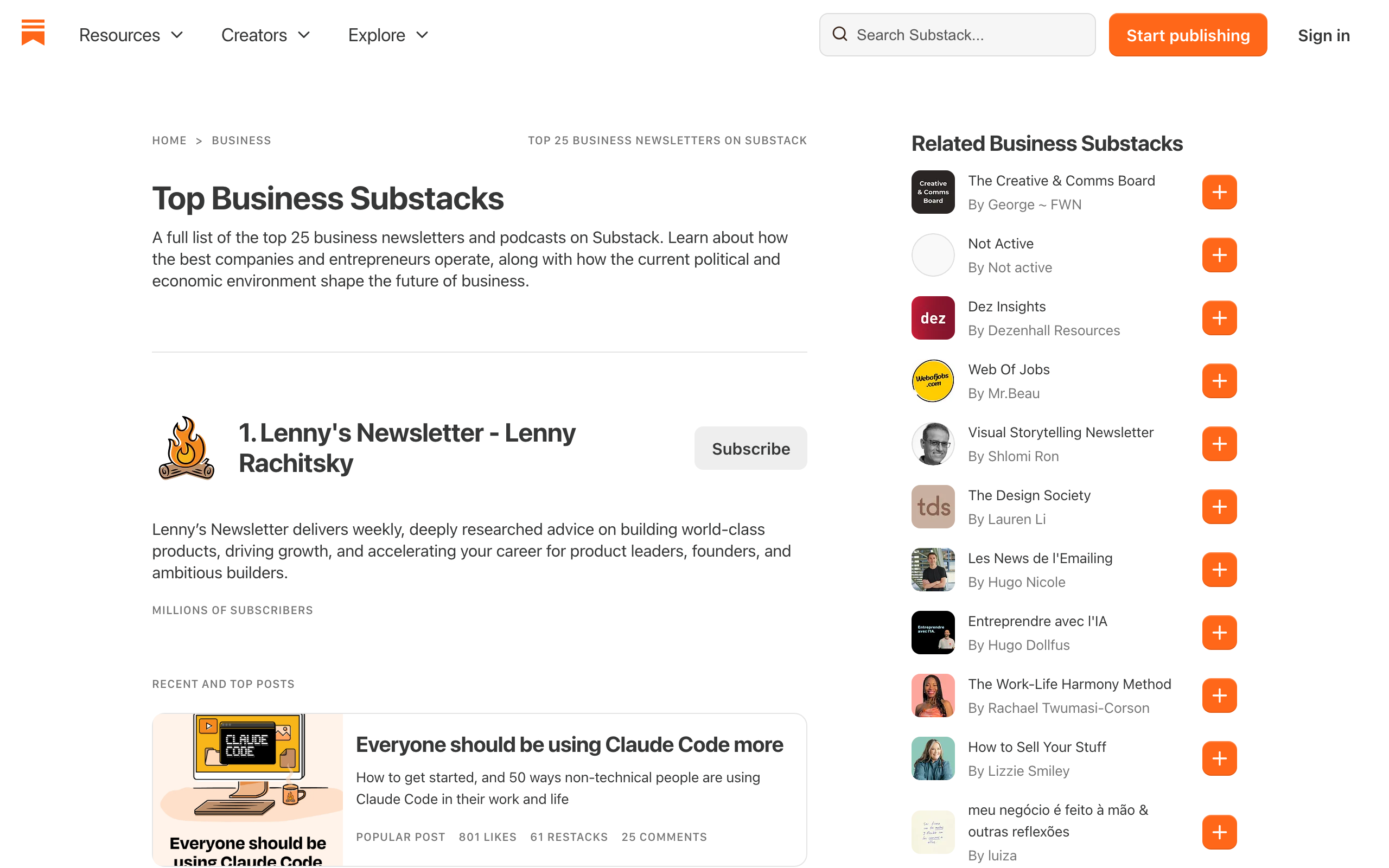
So the honest question is whether the network is worth 10%, and for a new writer it plainly is. Nothing beehiiv sells sends you a reader who was not already reading newsletters. beehiiv's recommendation network trades subscribers between publications and its Boosts marketplace lets you buy them outright, which is a different thing: those are levers for someone who already has traffic to trade or budget to spend. Substack's leaderboards and cross-recommendations hand readers to people with neither. (Open the Top Business list and the number one is Lenny's Newsletter, whose most popular recent post is about getting more out of Claude Code. Millions of subscribers, and the discovery rail beside it is pointing at strangers.)
Where 10% stops being fair is a specific and knowable moment: when your new subscribers are coming from you rather than from the network. Your podcast, your search traffic, your LinkedIn, your existing list. At that point Substack is charging a permanent commission on an introduction it did not make, and the fee has quietly become the most expensive line item in a business with no other line items.
The crossover, at your list size
The rule is short: beehiiv gets cheaper the month your paid revenue passes ten times beehiiv's monthly bill. Ten times, because Substack's cut is 10%.
Put your list size in and you get your number. At 1,000 subscribers beehiiv wants $49, so the line is $490 a month in paid revenue. At 5,000 it is $890. At 10,000 it is $1,090. At 25,000, $1,690. At 100,000, $3,290. Below your line, Substack is cheaper and you should stop thinking about this. Above it, every month you stay is a donation.
Two real scenarios, because percentages hide the size of the thing. A 1,000-person list converting 3% at $8 a month brings in $240. Substack takes $24 of that. beehiiv would want $49 whether those 30 people paid or not, so Substack wins by $25 a month and you keep the network for free. Now the same list at 10,000 subscribers and the same rates: $2,400 a month in, Substack takes $240, beehiiv takes $109. That is $131 a month, $1,572 a year, for sending an identical email to identical people.
Here is the part that makes it a one-way door. beehiiv's price per subscriber falls as you grow: 4.9 cents a subscriber a month at 1,000, 1.1 cents at 10,000, 0.3 cents at 100,000. Substack's cut is a flat 10% of everything, forever, no matter how big you get. So the two lines cross exactly once and then keep separating. If you cross it convincingly, you are not going to cross back, and you can stop re-running the maths every quarter.
One case the table above does not cover: a large free list with no paid tier at all. If that is you, this decision does not exist. Stay on Substack, pay nothing, and revisit it the week you turn payments on. Every hour spent on platform choice before there is revenue is an hour of tool shopping dressed up as work.
What moving actually costs
Less than the internet says, and more than nothing. The free list is a CSV, which is the boring part. The paid subscribers are the part people assume is impossible, and it is not: both platforms bill through Stripe, and beehiiv documents a migration where you copy the customers, payment methods included, from the Stripe account connected to Substack into the one connected to beehiiv. Nobody has to dig out a card. The caveat in beehiiv's own instructions is worth reading before you start, because subscribers charged in a currency other than your set price do not come across.
What genuinely does not move is everything Substack was doing for you while you slept. The recommendations other writers point at your publication. Your position in the network. The app. Your archive lives at new URLs, and if you were getting search traffic to old posts you will feel that for a few weeks. Note also that you cannot creep onto beehiiv gently, because the free tier cannot take a payment: the day you move a paid list you are on Scale, at your list size, paying before you have proved anything.
It is not worse. It is different, and different is uncomfortable for exactly as long as it takes a renewal to come around. You go from a platform that finds readers to a machine you have to feed, and the first month feels slower because it is. Do it anyway once your number says so, and do it in the dullest possible way: run both for a month, move the archive before you move the people, and tell readers once instead of apologising three times.
The call
Substack, until your paid revenue is past ten times what beehiiv would bill you for a list your size. Then beehiiv Scale, on annual billing, and use the referral tooling you are suddenly paying for. Nobody paying you yet? Substack, free, and this whole page is a bookmark for later. The mistake is not picking wrong, it is paying beehiiv's rent for a year while a free Substack would have taken $0 from a list that earned $0. Our one blog slot in the 22-tool stack is still Substack for that reason, and the tool that sends your actual campaigns is a separate decision.
Start on Substack. It costs nothing until a reader pays you, and its network puts your writing in front of people who were not looking for it, which is the one thing you cannot buy at any price when you are starting from zero. Move to beehiiv when your paid revenue passes about ten times what beehiiv would charge you: roughly $490 a month at a 1,000-person list, $1,090 at 10,000. Below that line Substack's 10% cut is cheaper than beehiiv's rent, and it is not close enough to be worth a weekend of research. Above it, you are paying Substack a salary for a network you have stopped needing.
Honest FAQ
Is Substack or beehiiv better?
Substack for almost anyone who is not yet earning real money from paid subscriptions, because it costs nothing until a reader pays and its network sends you readers you did not go and find. beehiiv once your paid revenue is past about ten times its monthly bill for your list size, roughly $490 a month at 1,000 subscribers, because at that point its 0% take rate saves more than the plan costs.
How much does beehiiv cost in 2026?
Launch is free up to 2,500 subscribers. Scale, the cheapest tier that can charge for subscriptions, is priced by list size: $49 a month at 1,000 subscribers on monthly billing, $89 at 5,000, $109 at 10,000 and $329 at 100,000. Annual billing brings the 1,000-subscriber price down to $43 a month, billed as $517 a year. Max starts at $109 a month at 1,000 subscribers.
Can you charge for subscriptions on beehiiv's free plan?
No. Paid subscriptions start on Scale. The ad network, programmatic ads, the referral program and Recommendations placements are also off on the free Launch tier, so every feature that earns you money needs a paid plan. Launch is genuinely good for a free newsletter under 2,500 subscribers and useless the moment you want to take a payment.
What does Substack actually take?
10% of your paid subscription revenue, with no cap and no volume discount, for as long as that subscriber keeps paying. Stripe's processing fee of 2.9% plus 30 cents sits on top, but beehiiv charges you the same Stripe fee, so it makes no difference to the comparison. Publishing itself is free at any subscriber count, and the only fixed cost is $50 once for a custom domain.
At what point is beehiiv cheaper than Substack?
When your monthly paid revenue passes ten times beehiiv's monthly bill for your list size. That is about $490 at 1,000 subscribers, $890 at 5,000, $1,090 at 10,000 and $3,290 at 100,000. beehiiv's price per subscriber falls as your list grows while Substack's 10% never does, so the lines cross once and then keep separating.
Can I move my paid subscribers from Substack to beehiiv?
Yes. Both bill through Stripe, and beehiiv documents a migration that copies your customers and their payment methods from the Stripe account connected to Substack into the one connected to beehiiv, so subscribers do not re-enter card details. Subscribers charged in a different currency to your set price are the exception and do not migrate. What you lose instead is the discovery network, the app placement, and the search traffic pointing at your old post URLs.